DC-cable for Garching fusion reactor
DC power cable for Garching fusion reactor
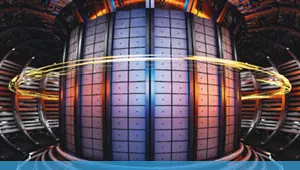
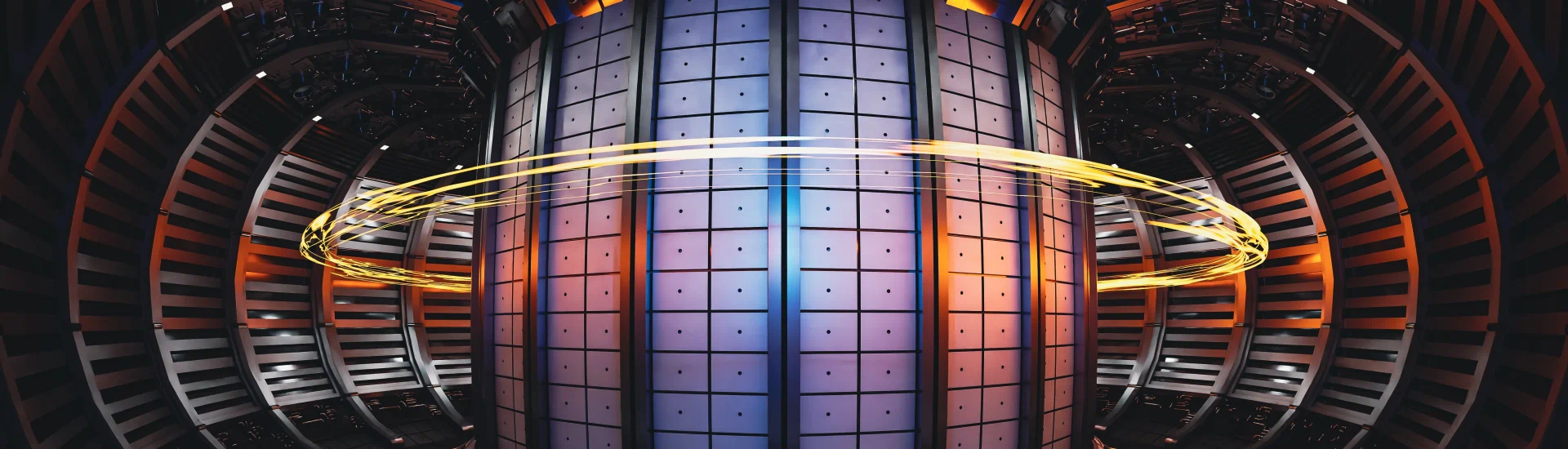
The research goal of the Max Planck Institute for Plasma Physics (IPP) in Garching is to investigate the physical principles underlying a fusion power plant, which – similar to the sun – is intended to generate energy from the fusion of atomic nuclei. To this end, the IPP is conducting the large-scale ASDEX Upgrade (Axially Symmetric Divertor Experiment, AUG) experiment. It belongs to the tokamak family and is designed to investigate key questions in fusion research under power plant-like conditions. Bayka supplied custom-made DC power cables to supply power to two recently retrofitted magnetic coils on the upper divertor.
Challenge
Divertors are made of extremely heat-resistant materials such as tungsten or molybdenum. Put simply, their main task is to use strong magnetic fields to keep the 100 million degree plasma flow inside the tokamak reactor as far away as possible from the vessel wall, deflecting it onto cooled baffle plates and thereby removing the ‘fusion ash’ helium and impurities that arise from the inevitable contact with the wall. The new coils at the AUG are connected in anti-series and connected to the power converter via DC cables.
In typical operation, experiments are run two to three times a week. Up to 30 discharges (pulses) are performed within a maximum operating time of approximately 10 hours. There is typically more than 15 minutes between discharges. The cables are therefore energised up to 30 times a day for 3–10 seconds and have more than 900 seconds of cooling time in between.
Solution
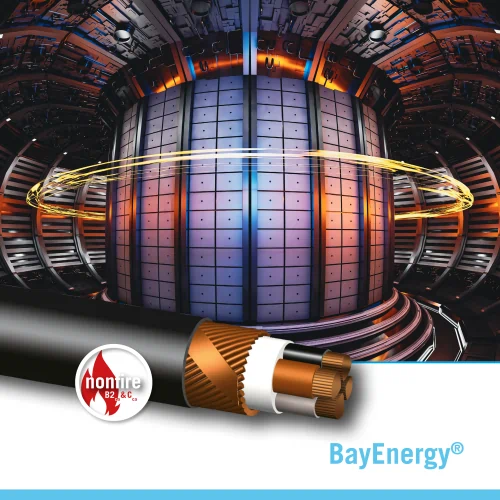
Thanks to its in-house development, design and testing capabilities and highly flexible machinery, Bayerische Kabelwerke is not only able to advise customers on complex requirements, but also to manufacture the corresponding special cables in small quantities. The connection between the coils and the power converter was achieved using two parallel cables (each 4x 240 mm²). To reduce the external field, each cable has two wires as forward and return conductors. The maximum short-term current across both cables together is 13 kA for a maximum of 3 seconds (pulse mode).